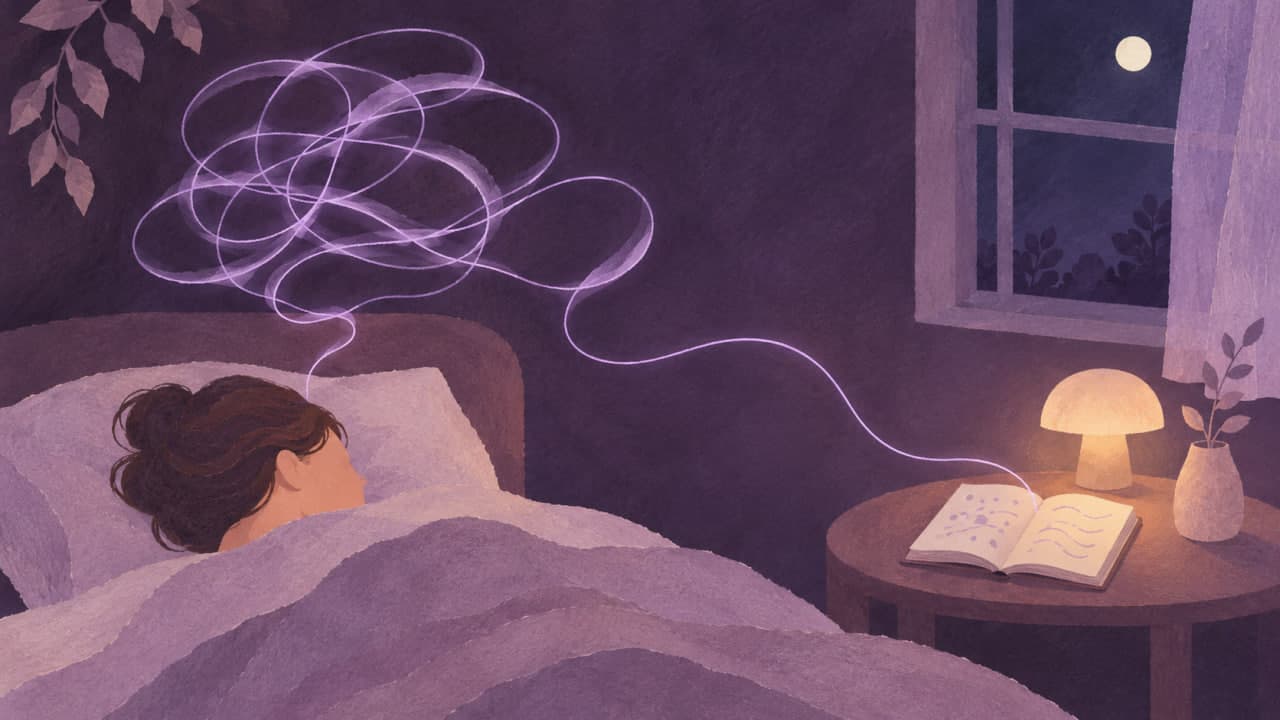
The light is off, the phone is down, you're finally lying in bed. And then your head switches on: that conversation you should have ended differently, the email you never sent, tomorrow broken down point by point. Every thought wants to be thought through to the end, but there is no end – they just go round in circles. Let's look at why this happens and how to step out of the loop.
What it looks like

Replaying things over and over (psychologists call it rumination – repeatedly chewing on the same thoughts) rarely feels like "anxiety." It feels more like work your brain just can't hand in:
- the same scene plays again and again, with different versions of "I should have said…"
- tomorrow's to-do list gets rebuilt for the tenth time
- your thoughts jump from one thing to another but keep coming back to the same topic
- you know you won't come up with anything new, but you can't stop
- the longer you lie there, the more annoyed you get at yourself for not sleeping – and that becomes one more thing to replay
That last point matters. At some point, thoughts about your to-dos turn into thoughts about sleep itself: "if I don't fall asleep now, tomorrow will be awful." And the loop closes.
Why thoughts switch on in bed

During the day your thoughts have no room: work, people, screens, noise. In the evening all of that switches off, and in the quiet the only source of signals left is your own head. Whatever got pushed to "later" during the day has been waiting for exactly this moment.
Psychologist Allison Harvey, who studies insomnia, described it as a self-sustaining cycle: worrying before sleep raises tension in the body, tension makes it hard to fall asleep, and not being able to fall asleep gives you a new reason to worry – now about sleep itself. Your attention starts latching onto any sign that "it's not working again," and that makes sleep even harder.
There's a second trap. When thoughts keep you awake, the most natural thing is to order yourself: "enough, stop thinking about it." But research on thought suppression suggests that in people with insomnia this tends to hold a thought in place rather than remove it: the brain keeps checking whether it has come back – and that brings it back.
The good news: because it's a cycle, it can be broken in several places.
What you can try right now

None of these steps "switches off" your head at the flick of a switch. Their job is more modest and more realistic – to give your thoughts somewhere else to go and your brain something else to do.
Offload your to-do list onto paper
A few minutes before you go to bed, take a piece of paper and write down what you need to do tomorrow and over the next few days. The more specific, the better: not "sort out work," but "reply to Sam about the report by noon."
In a small study that measured sleep in a lab, people who spent five minutes writing tomorrow's to-do list fell asleep faster than people who wrote about what they had already done – and the more detailed the list, the faster sleep came. It seems to work as offloading: your brain no longer has to hold everything so it won't forget.
If a thought pops up once you're already in bed, keep a notebook nearby and write it down in one line. Don't solve it – just write it down.
Give worry a slot during the day
This is a technique from cognitive behavioral therapy that's sometimes called "constructive worry". In the early evening, well before bed, set aside 15 minutes and divide a sheet into two columns:
- on the left – what's worrying you
- on the right – one small next step for each item, even if it's "nothing I can do yet, I'll come back to this on Friday"
Then fold the sheet and put it away. If the same thought comes back at night, you can remind yourself: "I've already thought about this; it has a step and a time." It isn't magic, but it's easier for the brain to let go of a problem that already has a plan.
Don't fight the thoughts – shuffle pictures
Since banning thoughts doesn't work, replacing them does. One way is cognitive shuffling: pick a neutral word (say, "lamp") and for each of its letters in turn think of words and picture each one as an image. L – lemon, lake, ladder. A – apple, anchor, ant. Don't rush; stay with each image for a couple of seconds.
The task is busy enough to crowd out rumination and pointless enough not to wake you up. Falling asleep itself works on a similar principle: thoughts before sleep become random and disconnected. There isn't much research on this technique yet, but in early trials with students it helped about as well as planning during the day, and people found it easier to use.
If something physical suits you better, slow breathing exercises with a long exhale or 5-4-3-2-1 grounding can help you switch – in the dark you can do it with sounds and sensations.
Can't sleep – get up
If you feel sleep isn't coming and your thoughts are only speeding up, don't lie there trying to talk yourself into it. Get up, go to another room or at least sit up, turn on a dim light and do something calm and boring: a paper book, a warm caffeine-free drink, folding laundry. Go back to bed when you feel sleepy.
It sounds counterintuitive, but it's part of stimulus control – one of the methods recommended for insomnia. The point is for your bed to become a place for sleep again, not for wrestling with thoughts. Better not to check the clock while you're at it: counting the hours left until the alarm is a sure way to add one more worry to the loop.
We're on Telegram
Subscribe to our channel so we're close by. From there you can always message a listener anonymously.
When it's more than self-help

These steps work well when the rumination is tied to a specific stressful period. But sometimes its roots go deeper. It's worth talking to a professional if:
- thoughts keep you from falling asleep almost every night for more than a few weeks
- during the day you feel wrecked, it's hard to focus and everything irritates you
- what goes round in circles is mostly thoughts of your own guilt, worthlessness, or that nothing has any point
- panic attacks at night have joined the rumination, and in the morning you have no energy to get up
Chronic insomnia isn't a "bad habit" – it's a condition people know how to work with. The American Academy of Sleep Medicine names cognitive behavioral therapy for insomnia (CBT-I) as the main treatment: usually 4–8 sessions that work on both the behavior around sleep and the thoughts that rev it up. It's not pills and not endless therapy but a concrete program.
If thoughts that you don't want to live show up among the nighttime ones, don't wait for morning and don't keep it to yourself: helplines are open around the clock, free and anonymous.
When you'd like someone to talk to
Sometimes self-help isn't enough, and that's okay. Our Telegram channel has a link to message a listener — free and anonymous.
Nighttime thoughts often seem bigger and scarier than they are, simply because in the dark there's nothing to compare them with. By morning many of them shrink back to the size of an ordinary task. You don't have to solve them tonight – it's enough to give them a place on paper and come back to them during the day.
Sources
- Harvey A. G. (2002). A cognitive model of insomnia. Behaviour Research and Therapy, 40(8), 869–893.
- Harvey A. G. (2003). The attempted suppression of presleep cognitive activity in insomnia. Cognitive Therapy and Research, 27(6), 593–602.
- Schmidt R. E., Harvey A. G., Van der Linden M. (2011). Cognitive and affective control in insomnia. Frontiers in Psychology, 2, 349.
- Scullin M. K., Krueger M. L., Ballard H. K., Pruett N., Bliwise D. L. (2018). The effects of bedtime writing on difficulty falling asleep: A polysomnographic study comparing to-do lists and completed activity lists. Journal of Experimental Psychology: General, 147(1), 139–146. Baylor University press release
- Carney C. E., Waters W. F. (2006). Effects of a structured problem-solving procedure on pre-sleep cognitive arousal in college students with insomnia. Behavioral Sleep Medicine, 4(1), 13–28.
- Beaudoin L. P., Digdon N., et al. (2016). Poster on serial diverse imagining. SLEEP 2016, Denver.
- Edinger J. D., et al. (2021). Behavioral and psychological treatments for chronic insomnia disorder in adults: an American Academy of Sleep Medicine clinical practice guideline. Journal of Clinical Sleep Medicine, 17(2), 255–262.